Showing posts with label Week 1. Show all posts

Sunday, September 6, 2009

Cultural Exchanges Only! No Refunds!

I found "Cultural Exchange" to be the poem that resonated with me the most this time around. As an artist, I appreciate the symmetry of this work, how it begins with two lines with thirteen syllables each, giving us the sing-song rhythm of the "lovely Lieder." I also enjoy the alliteration of "dust of dingy" and "scratchy sound." And who could not enjoy saying "Leontyne" over and over with its melodic strains wafting through the kitchen where the collard greens are cooking? But what else is cooking in this poem? We are immediately set aside from the rest of the world by being placed into the "Quarter of the Negroes." Quarter has so many implications as a chosen word. Not only does it mean "living space", it also implies something not quite whole. This small space to which black society has been relegated, not unlike the ghettos of the Jews during the shoah. It also means, in the context of war, protection: when the enemy is offered quarter. The poet is both protected in this quarter and constrained within it. Open the door to this quarter and you hear the lovely strains of music. Leontyne is singing and soul food is cooking. The gentle stewing even feels gentle, soulful, and like home.  And yet, this peaceful quarter is interrupted by the knowledge that one must find the "colored" laundromat. And will your skin color rub off? Hughes punctuates the awkwardness of this question with an awkward syntax: "They asked me if my blackness/Would it rub off?" sounds much more unusual than "They asked me if my blackness/would rub off." Yet this is not what Hughes has chosen. Why?

My issue with the work comes from Hughes' description of "the COLORED HOUR." In this hour, the poet plays out the fantasy that black culture has supplanted the white culture and the tables have been turned. The poet's anger and sarcasm is displayed here (and rightfully so) yet his suggestion does not solve any problems. It only changes the identity of the oppressor. I think Hughes explanation of the COLORED HOUR is quite comical and interesting. In fact, I love thinking about the white mammies and how they are sometimes "buried with our family." The plot line resembles that of the Planet of the Apes in which animals turn the tide against their human oppressors. However, much like the movie, Planet of the Apes points out that the species of the oppressor doesn't matter. It's the model that matters. In the oppressor/oppressed model, there must always be a winner and a loser, a have and a have not. For this reason, Hughes suggestion doesn't go the distance with me in creating a solution that will work toward solving the problem of racism. Of course, one must acknowledge that perhaps that is not Hughes' point. Perhaps this poem is about revealing the problem and not about solving it. But I feel that in the current state of our world, we must now move beyond the naming of the problem and into the solving of it if we are to make any progress at all.

--H. K. Rainey 

Friday, September 4, 2009

Weary Blues is a Classic/ I'm feelin this video poem thang

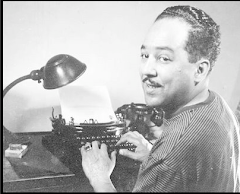
Langston Hughes speaks of strife of the African American experience in his 1923 video poem "Weary Blues" when he says, "He made that poor piano moan with melody."   Images of Black performance spaces, The Apollo, The Savoy, and Cab Calloway dancing against the melancholy jazz background add a layered canvas to Hughes's painting of poetics.  I enjoyed the intermingling of genres: dance, music, poetry and the striking metaphor of the anguished blues musician (piano player) as symbol of the period's political climate and it's effects on Black men which can still very much be likened to conditions today.  In regards to technique Hughes is master here at using rhythm, rhyme, and metaphor.  "Weary Blues" is a classic in every sense--Hughes's development of craft, meaningful content, and historical narrative.  This video poem poem was from 1923 and it is timeless and inspiring!  


How come we don't have a multimedia poetry class at Mills?  I'd love to learn how to create a video poem. Also, how cool it would be to have a poetry video channel as an alternative to the majority "fluff" of music videos we have now.


Mica

Sunday, August 30, 2009

Langston Hughes--Surprisingly Refreshing

Many comments that mirror my own have been made here about Hughes' work, his place in African American history and poetry, and on the language he used (deliberate or not). So in an attempt not to repeat, I want to look at one other element that has not been discussed – aesthetics.

As I listened to him share The Weary Blues I found it interesting that he paused in different places that were not indicated by line breaks or commas or any other signifier that we have come to equate with a pause for the reading voice. I realize that I am placing an aesthetic that was not of concern in his time onto this historically brilliant work, but that is my point – why do we trouble ourselves with aesthetics now? Have we decided that traditional aesthetics can no longer serve some arbitrary importance that we (modern/contemporary/aspiring poets) have placed on how our poetry looks on the page? Do we really think that how we place text on the page will somehow guide the reader to read it the way we want them to read it? How DO we want them to read our poetry? Does it matter? Is it content/context that matters more or is it the performance of the poetry – the actual reading it out loud?

Obviously, these rhetorical questions are simply me searching my own purpose for “doing what I do” on the page. This first assignment has moved me to reflect on my choices to write some poems that rely on the aesthetics to move the piece forward and some pieces that seem to beg me to stick with more traditional forms. I have no answers to these questions and don’t expect anyone else to define the importance for me, but I am ridiculously hopeful that we can discuss and my eyes/mind/poetic heart can open and learn and question and create.

I also found it interesting that I’ve read Hughes’ work many, many, many times and never experienced it quite the way I did this time. I love that!!

peacelovelight

Kiala